
 Photo by FT
Photo credit: Pexels
- The five companies have five-year betas ranging from 0.20 to 0.46, compared with the Magnificent Seven’s average of approximately 1.45.
- Forward dividend yields range from 1.9% for Johnson & Johnson to 6.0% for Altria, offering higher income than the Magnificent Seven’s average yield of 0.32%.
- Coca-Cola, Johnson & Johnson, McDonald’s, Altria and Colgate-Palmolive operate in different industries, with distinct earnings drivers and business risks that investors should assess alongside dividend yields and beta.
NEW YORK, Nov. 11, 2026 — The Magnificent Seven have driven much of the stock market’s gains in recent years, supported by demand for artificial intelligence (AI), cloud computing, digital advertising and consumer technology. Amazon (AMZN), Microsoft (MSFT), Alphabet (GOOG/GOOGL), Nvidia (NVDA), Apple (AAPL), Tesla (TSLA) and Meta Platforms (META) have delivered substantial returns, but their shares have also shown greater sensitivity to market movements than many established dividend-paying companies.
According to Yahoo Finance, the Magnificent Seven had an average five-year monthly beta of approximately 1.45. Microsoft recorded the group’s lowest beta at 1.04, while Nvidia had the highest at approximately 2.3.
The Magnificent Seven pay relatively little in dividends. Their average forward dividend yield was approximately 0.32%. Amazon and Tesla pay no dividends, while Microsoft’s forward yield was approximately 0.74%. Investors in these companies generally rely more on share-price appreciation driven by future earnings growth. Much of that growth potential is tied to substantial spending on data centers, semiconductor infrastructure, networking equipment and cloud capacity.
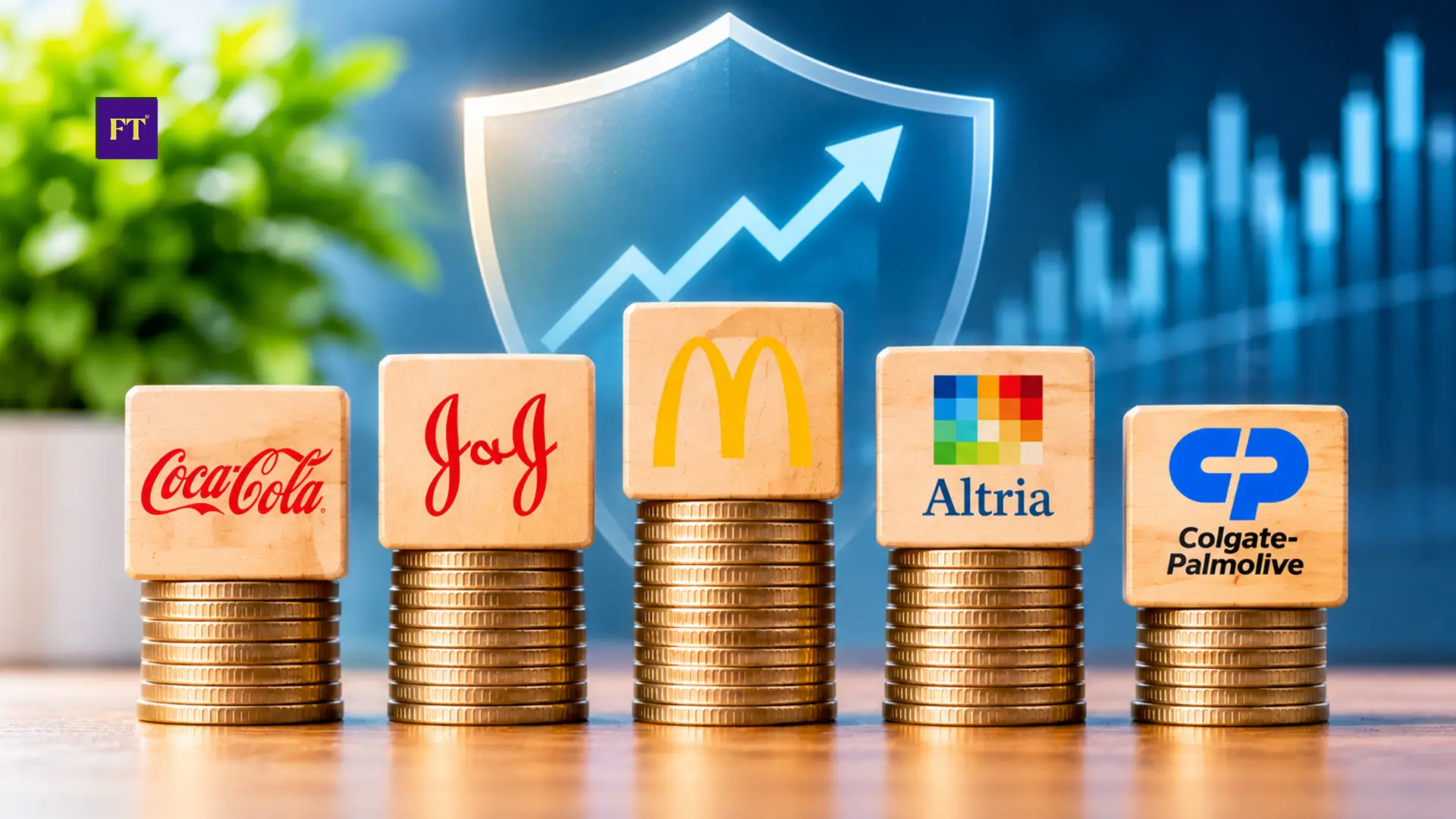
Investors seeking dividend income and lower market sensitivity can consider established companies with lower betas and higher yields. Five companies meeting the screening criteria of a beta of 0.5 or lower and a forward dividend yield of at least 1.9% are Coca-Cola (KO), Johnson & Johnson (JNJ), McDonald’s (MCD), Altria (MO) and Colgate-Palmolive (CL).

Coca-Cola’s Dividend Record
Coca-Cola, founded in 1886, has raised its annual dividend for 64 consecutive years, earning recognition as a Dividend King. The stock had a five-year beta of 0.27 and a forward dividend yield of approximately 2.2%.
The beverage company produces concentrates and syrups, while independent bottling partners manufacture, package, and distribute finished drinks. This arrangement allows Coca-Cola to generate revenue from its brands and beverage formulas without directly operating every bottling facility.
Coca-Cola reported an operating margin of 33.4% for the third quarter of 2026, compared with 32% a year earlier. The company’s forward price-to-earnings ratio was approximately 27.5. Berkshire Hathaway is a major shareholder, reflecting Warren Buffett’s long-standing interest in the business. Buffett has explained his investment philosophy this way: “It's far better to buy a wonderful company at a fair price than a fair company at a wonderful price.”
Coca-Cola also recorded 6% unit case volume growth in Latin America during the third quarter. The region remains an important source of sales for the beverage company.
Johnson & Johnson’s Healthcare Focus
Johnson & Johnson, founded in 1886, has raised its annual dividend for 64 consecutive years. The stock had a five-year beta of 0.20, the lowest among the five companies in this group, and a forward dividend yield of approximately 1.9%.
The company now focuses on pharmaceuticals and medical technology following the separation of its consumer healthcare business, which included brands such as Tylenol, Listerine and Band-Aid, into Kenvue. Johnson & Johnson's principal business activities now center on its pharmaceutical and medical technology operations.
More than 75% of Johnson & Johnson’s sales come from businesses with No. 1 or No. 2 global market shares. Over the past five years, the company has returned more than 65% of its free cash flow to shareholders through dividends and share repurchases.
The company’s low beta, dividend record, and pharmaceutical and medical technology businesses give investors exposure to healthcare with less historical sensitivity to market movements than the Magnificent Seven.
McDonald’s Franchise Economics
McDonald’s had a five-year beta of 0.43 and a forward dividend yield of approximately 2.7%. The restaurant company has raised its annual dividend for 50 consecutive years.
Most McDonald’s restaurant locations operate under franchise agreements. In many cases, the company owns the underlying real estate and collects rent from franchisees, generating revenue from both franchise operations and property holdings. The structure also limits the company's direct responsibility for operating individual restaurants.
McDonald’s reported a net profit margin of approximately 32.4%. In the third quarter of 2026, comparable sales rose 1.4% in international operated markets and 4.2% in international developmental licensed markets. Yahoo Finance listed the company's dividend payout ratio at approximately 58.9%.
The franchise system, real estate holdings, and dividend record distinguish McDonald's from technology companies whose valuations and earnings prospects are more closely tied to technology spending and investor expectations for future growth.
Altria’s High Dividend Yield
Altria had a five-year beta of 0.46 and a forward dividend yield of approximately 6.0%, the highest among the five companies. The tobacco company's business includes premium combustible products, particularly Marlboro, and oral tobacco products.
The tobacco industry faces regulatory restrictions, higher taxes, and limits on advertising. Declining cigarette smoking rates also present a long-term business challenge. These factors make Altria's high yield important to assess alongside its earnings, cash flow and dividend payout ratio.
Altria's dividend payout ratio was approximately 89.3%, according to the latest available Yahoo Finance data. For the third quarter of 2026, net revenue rose 1% year over year to $6.13 billion. Revenue after excise taxes rose 3.6% to $5.44 billion.
During the first nine months of 2026, Altria repurchased 11.2 million shares at an average price of $65.78, for a total of approximately $735 million. The company's board also authorized a $1 billion addition to its share repurchase program. The authorization expires in December 2027.
The high dividend yield may appeal to income-focused investors, but the payout ratio, regulatory exposure and long-term decline in cigarette consumption warrant attention.
Colgate-Palmolive’s Consumer Brands
Colgate-Palmolive had a five-year beta of 0.31 and a forward dividend yield of approximately 2.2%. The company has paid uninterrupted dividends since 1895.
Colgate-Palmolive’s portfolio includes Colgate, Palmolive, Speed Stick, Ajax, Irish Spring and Softsoap, as well as Hill's Science Diet and Hill's Prescription Diet pet nutrition products. The brands span oral care, personal care, household products and pet nutrition.
For the third quarter of 2026, Colgate-Palmolive reported a 4.6% rise in GAAP net sales and a 3% increase in GAAP earnings per share to $0.94. GAAP gross profit margin rose 80 basis points to 60.2%. The company held a 41.4% share of the global toothpaste market and a 33.1% share of the global manual toothbrush market, based on year-to-date figures.
Colgate-Palmolive’s trailing price-to-earnings ratio was approximately 38.2. The valuation is worth considering alongside its low beta, dividend record, and established consumer brands.

Photo credit: Pexels
Returns and Risks
The five companies have lower five-year betas and higher forward dividend yields than the Magnificent Seven’s respective averages. Their figures also show differences in income levels and business risks.
The figures provide a starting point for comparing dividend income and historical market sensitivity, not a guarantee of future returns or protection from losses. Beta measures past share-price sensitivity and can change over time. Dividend yields also fluctuate with share prices, and companies can reduce or suspend dividend payments.
The five stocks represent different industries and carry distinct risks. Coca-Cola and Colgate-Palmolive depend on consumer demand for branded products; Johnson & Johnson faces pharmaceutical and medical technology business risks; McDonald's depends on restaurant sales and franchise operations; and Altria faces regulatory restrictions and declining cigarette consumption.
Investors comparing these stocks with the Magnificent Seven should assess dividend sustainability, earnings, cash flow, valuation, and industry-specific risks alongside beta and yield. A lower beta and a higher dividend yield may suit an income-focused investment strategy, but neither measure alone establishes whether a stock is attractively valued or appropriate for a particular portfolio.
According to Yahoo Finance, the Magnificent Seven had an average five-year monthly beta of approximately 1.45. Microsoft recorded the group’s lowest beta at 1.04, while Nvidia had the highest at approximately 2.3.
Related Topics

Small Steps in Saving and Investing Build Real Wealth
Financial security grows from consistent habits, careful planning, and the discipline to stay the course.
By

How Saving and Investing Serve Different Roles in Long-Term Financial Planning
When people have financial goals that extend many years into the future, they often consider investing. Investing places money into assets that may grow in value over long periods such as stocks, bonds and funds that hold a mix of different securities.
By

Financial Literacy Remains Low Across Europe as Household Savings Remain Outside Investment Markets
Only 18% of EU citizens demonstrate high financial literacy, while trillions of euros remain in bank deposits, highlighting the gap between household savings and participation in investment markets.
By

Invest America and Everfi Launch Statewide Financial Education Initiative in Texas Schools
By bringing financial education into classrooms across Texas, we’re helping ensure that new opportunities to save and build wealth don’t just exist on paper but actually reach the students and families who stand to benefit most.
By